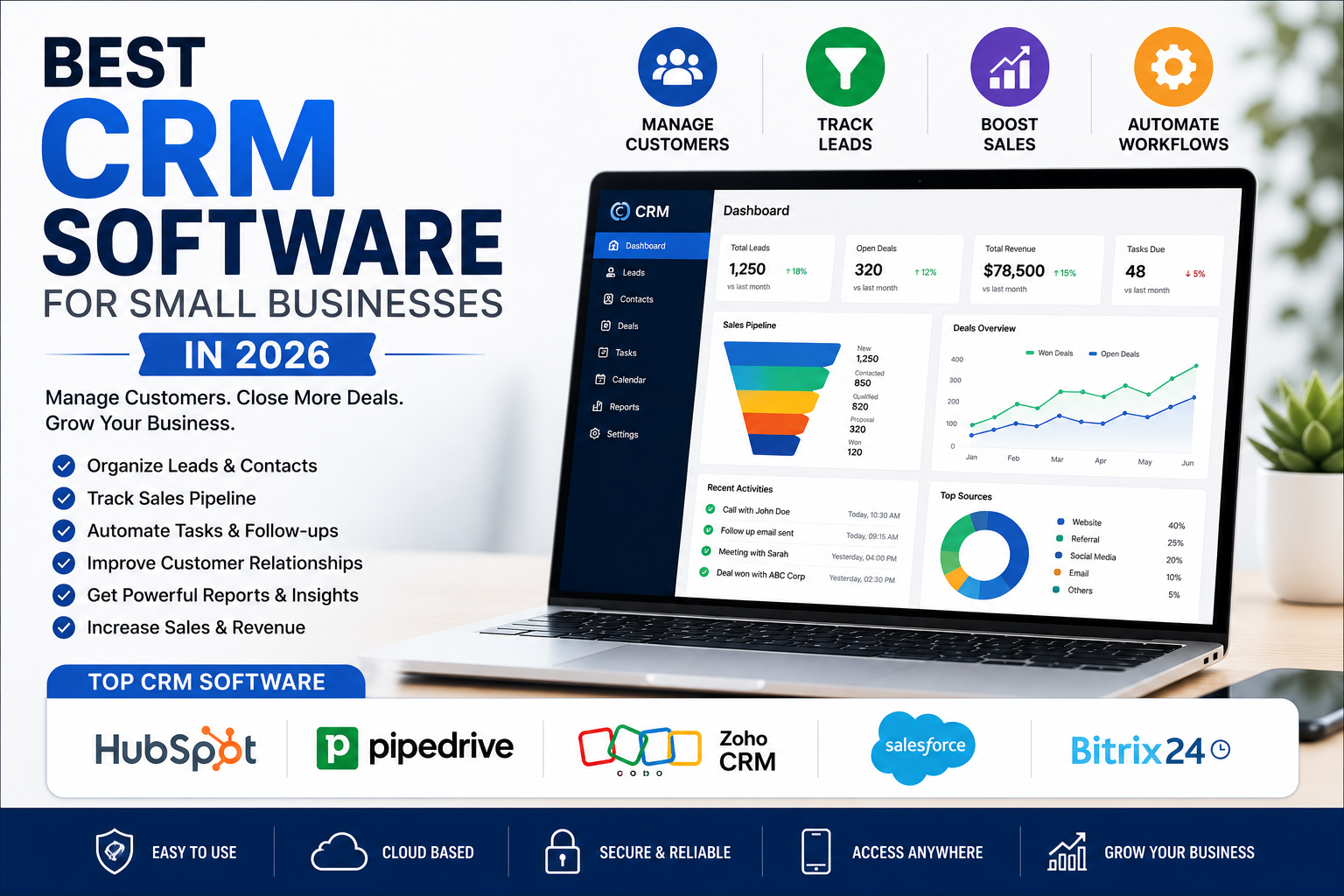
Running a small business in 2026 is more competitive than ever. Managing leads, customer relationships, sales tracking, and communication manually can slow down growth. That’s where CRM software (Customer Relationship Management) becomes essential.
The best CRM software for small business owners helps organize customer data, improve communication, automate tasks, and increase sales efficiency. Whether you run an online business, finance company, agency, or local service business, the right CRM can save time and improve profits.
In this guide, we’ll explore the top CRM software for small businesses in 2026, compare features, and help you choose the best platform based on your needs.
What Is CRM Software?
CRM software is a tool that helps businesses manage customer interactions, leads, sales pipelines, emails, and customer support in one place.
Instead of using spreadsheets or scattered tools, a CRM keeps everything organized so your business can:
- Track leads and customer activity
- Automate follow-ups
- Manage sales pipelines
- Improve customer retention
- Increase team productivity
- Analyze business performance
For small businesses, CRM software is no longer optional—it’s a growth tool.
Why Small Businesses Need CRM Software
Many small business owners think CRM tools are only for large companies. That is no longer true.
Today’s CRM platforms are affordable, easy to use, and designed specifically for startups and small businesses.
Here are the biggest benefits:
1. Better Lead Management
A CRM helps organize leads from websites, ads, emails, and phone calls. Instead of losing potential customers, every lead gets tracked automatically.
For example, if someone fills out a contact form, the CRM can instantly assign that lead and schedule a follow-up.
2. Sales Automation
Manual work wastes time.
Modern CRM software can automate:
- Emails
- Follow-ups
- Meeting reminders
- Task management
- Sales reporting
Automation allows business owners to focus on growth instead of repetitive tasks.
3. Improved Customer Relationships
Customer retention matters.
When you understand customer history, preferences, and communication records, you can provide better service and increase loyalty.
4. Better Revenue Tracking
CRM software gives insights into:
- Sales performance
- Lead conversion rates
- Revenue growth
- Customer lifetime value
This data helps business owners make smarter decisions.
Best CRM Software for Small Businesses in 2026
Here are the top CRM platforms worth considering.
1. HubSpot CRM
HubSpot remains one of the most popular choices for small businesses.
Pros:
- Free plan available
- User-friendly dashboard
- Email tracking
- Sales automation
- Marketing integration
Cons:
- Advanced features become expensive
Best For:
Startups and small businesses wanting an easy CRM.
HubSpot is excellent for businesses needing a simple but powerful CRM without technical complexity.
2. Salesforce Essentials
Salesforce is one of the biggest names in CRM.
Its Essentials plan is built for smaller companies.
Pros:
- Powerful automation
- Advanced analytics
- Strong integrations
Cons:
- Learning curve for beginners
Best For:
Businesses planning long-term growth.
If scalability matters, Salesforce is a strong investment.
3. Zoho CRM
Zoho CRM is a budget-friendly option with premium-level features.
Pros:
- Affordable pricing
- Workflow automation
- AI-powered sales assistant
- Good customization
Cons:
- Interface may feel overwhelming initially
Best For:
Budget-conscious small businesses.
Zoho offers excellent value without sacrificing functionality.
4. Pipedrive
Pipedrive is sales-focused CRM software.
Pros:
- Easy sales tracking
- Visual pipeline management
- Affordable plans
Cons:
- Limited marketing tools
Best For:
Sales-driven teams.
If your priority is converting leads faster, Pipedrive performs very well.
5. Freshsales CRM
Freshsales combines CRM and communication features.
Pros:
- Built-in phone system
- Email automation
- AI insights
Cons:
- Limited reporting in lower plans
Best For:
Businesses wanting all-in-one communication tools.
Key Features to Look for in CRM Software
Choosing CRM software can feel confusing.
Focus on these features:
Ease of Use
Complicated software slows teams down.
Choose a CRM with a clean interface and simple onboarding.
Automation Features
Look for automation tools like:
- Lead nurturing
- Email workflows
- Task reminders
Automation improves efficiency and saves hours every week.
Integrations
Your CRM should connect with:
- Email marketing tools
- Payment software
- Accounting platforms
- Customer support systems
Mobile Access
Many small business owners work remotely.
Mobile CRM access allows teams to manage leads anywhere.
Reporting and Analytics
Strong reporting helps identify:
- Sales trends
- Top-performing campaigns
- Revenue opportunities
How to Choose the Best CRM for Your Small Business
Not every CRM fits every business.
Ask yourself:
What Is Your Budget?
Some CRM systems offer free plans, while enterprise options cost more.
Small businesses should prioritize ROI over unnecessary features.
How Big Is Your Team?
Choose software that supports future growth.
Even if your team is small today, expansion matters.
What Features Matter Most?
Do you need:
- Sales automation?
- Customer support?
- Marketing tools?
- AI insights?
Choose based on business goals.
CRM Trends in 2026
CRM technology is evolving quickly.
Here are major trends shaping the industry:
AI Automation
Artificial intelligence is helping businesses:
- Predict customer behavior
- Improve lead scoring
- Personalize communication
Better Integrations
CRM platforms now integrate with almost everything, making operations smoother.
Mobile CRM Growth
Remote work continues increasing CRM mobile usage.
Customer Personalization
Businesses using personalized customer experiences see stronger retention and better profits.
Common CRM Mistakes Small Businesses Make
Avoid these mistakes:
Choosing Based Only on Price
Cheap software isn’t always better.
Focus on long-term value.
Ignoring Employee Training
Even great software fails without proper training.
Not Using Automation
Manual work limits growth.
Use automation whenever possible.
Choosing Overly Complex Tools
Simple systems often work best for small teams.
Final Thoughts
The best CRM software for small business owners depends on company size, budget, and goals.
If you want simplicity, HubSpot CRM is a strong choice.
If scalability matters, Salesforce Essentials works well.
For affordability, Zoho CRM delivers excellent value.
The right CRM can improve customer relationships, automate repetitive work, and help your business grow faster in 2026.
FAQs
What is the best CRM software for small businesses?
HubSpot, Zoho CRM, Salesforce Essentials, Pipedrive, and Freshsales are among the top choices for small businesses.
Is CRM software worth it for small businesses?
Yes. CRM software improves organization, sales tracking, customer management, and business efficiency.
Can small businesses use CRM for free?
Yes. Many platforms, including HubSpot CRM, offer free plans.
Which CRM is easiest to use?
HubSpot and Pipedrive are considered beginner-friendly and easy to manage.
How much does CRM software cost?
Pricing varies from free plans to premium subscriptions depending on features and business size.
